There is a moment when almost every prospective buyer hesitates for a second. You like the photos, the location is right, the numbers add up—and then the thought comes: “I’m supposed to send a six-figure amount over 9,000 kilometers. To a private individual. To a country whose land registry I don’t know.”
That hesitation is justified. And it is also the reason I wrote this post. Because the good news is: Buying real estate in Costa Rica is legally regulated in a surprisingly clean way—much more clearly than in some other Latin American countries. There is a central, publicly accessible land registry. There is a legally required notary. There are regulated escrow accounts.
What does not exist is automatic protection for the uninformed. If you know what to look for, you can buy safely here. If you do not, you can lose a lot of money.
In this post, you will get both: the full process with real figures—and the seven pitfalls European buyers most often overlook.
First, the most important question: Are foreigners even allowed to buy property in Costa Rica?
Yes—and with the same rights as Costa Ricans. That is not a given, and it is one of the reasons the country is so popular with expats.
You do not need residency, citizenship, or a local partner. Full, registered ownership (propiedad titulada), with your name in the national land registry.
There is exactly one major exception, and it is so important that it returns below as Pitfall No. 1: the coastal zone. The first 200 meters from the high-water line are not normal ownership—more on that in a moment.
The process: From “yes” to registration in the land registry
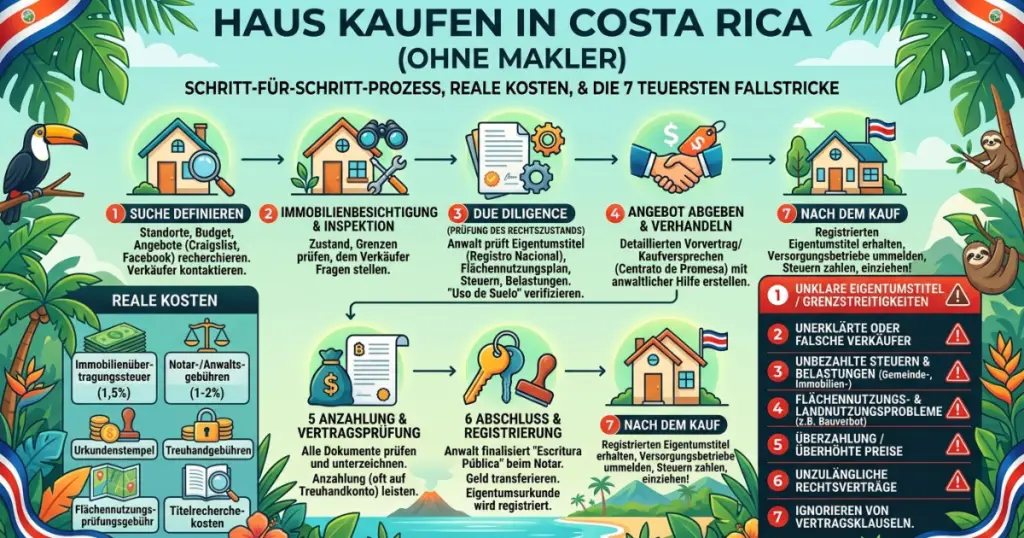
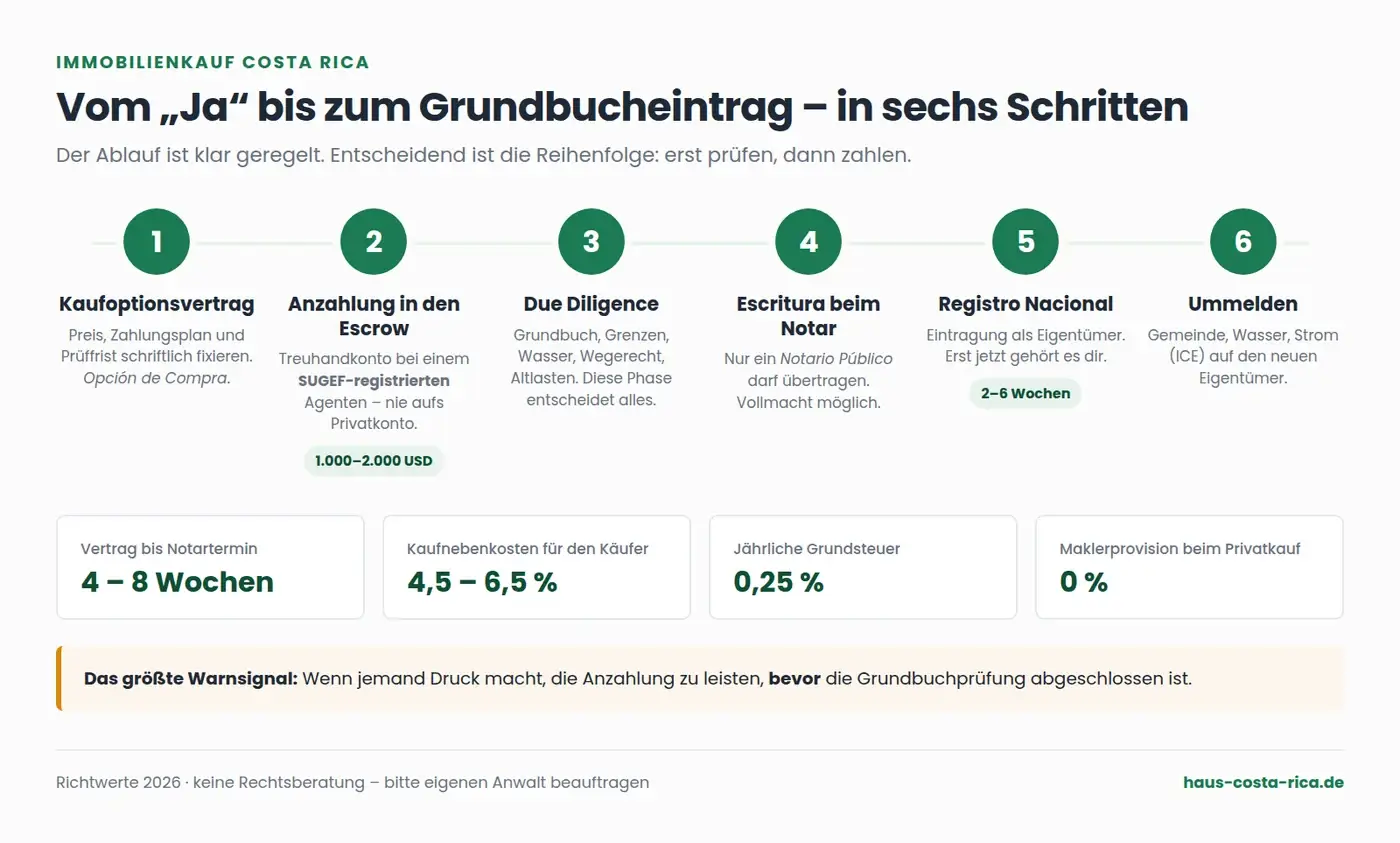
From the purchase option agreement to the notary appointment typically takes four to eight weeks, and then the land registry registration is added. The process has six steps.
Step 1 – Purchase option agreement (Opción de Compra)
First, everything that applies is set out in writing: purchase price, payment schedule, inspection period, what is included in the sale, when handover takes place, and what happens if the inspection reveals something unexpected. Only then does money move—and not to the seller, but into escrow.
A good option agreement also binds both sides, not just the buyer. It takes the property off the market for the inspection period and gives you time to review everything properly.
Step 2 – Down payment into escrow
The down payment goes into an escrow account with a SUGEF-registered escrow agent. SUGEF is Costa Rica’s financial regulator—a registered escrow agent is subject to anti-money-laundering checks and supervision.
This is the central safety mechanism of the entire process: your money is held neither by you nor by the seller, but by a regulated third party, which releases it only when the agreed conditions are met. The cost is typically USD 1,000 to 2,000.
If someone suggests wiring the down payment directly to their personal account: do not negotiate—simply decline.
Step 3 – Due diligence (the actual work)
Now your attorney or notary reviews the property. You will find what needs to be on the table further down as a checklist. This phase decides everything.
Step 4 – Escritura (the notary appointment)
In Costa Rica, only a Notario Público may transfer ownership—and here, that person is always also an attorney. The deed is read aloud and signed, and taxes and fees become due.
Important: You do not necessarily have to be present in person. An apostilled power of attorney (poder especial) is common—many buyers from Europe use this. I still recommend having been on site at least once.
Step 5 – Registration in the Registro Nacional
The notary files the deed with the national land registry. Realistically, expect two to six weeks—10 to 15 business days is the best case with an already digitized file; Costa Rican law firms often quote two to four weeks, and in individual cases longer. Only once it is registered are you the registered owner.
Step 6 – Transfer utilities and municipal registration
Finally, the municipality (Municipalidad), water provider, and electricity provider (ICE) are transferred into your name. It sounds trivial, but it is often forgotten—and later leads to bills being sent to the previous owner.
What the purchase really costs: all closing costs in figures
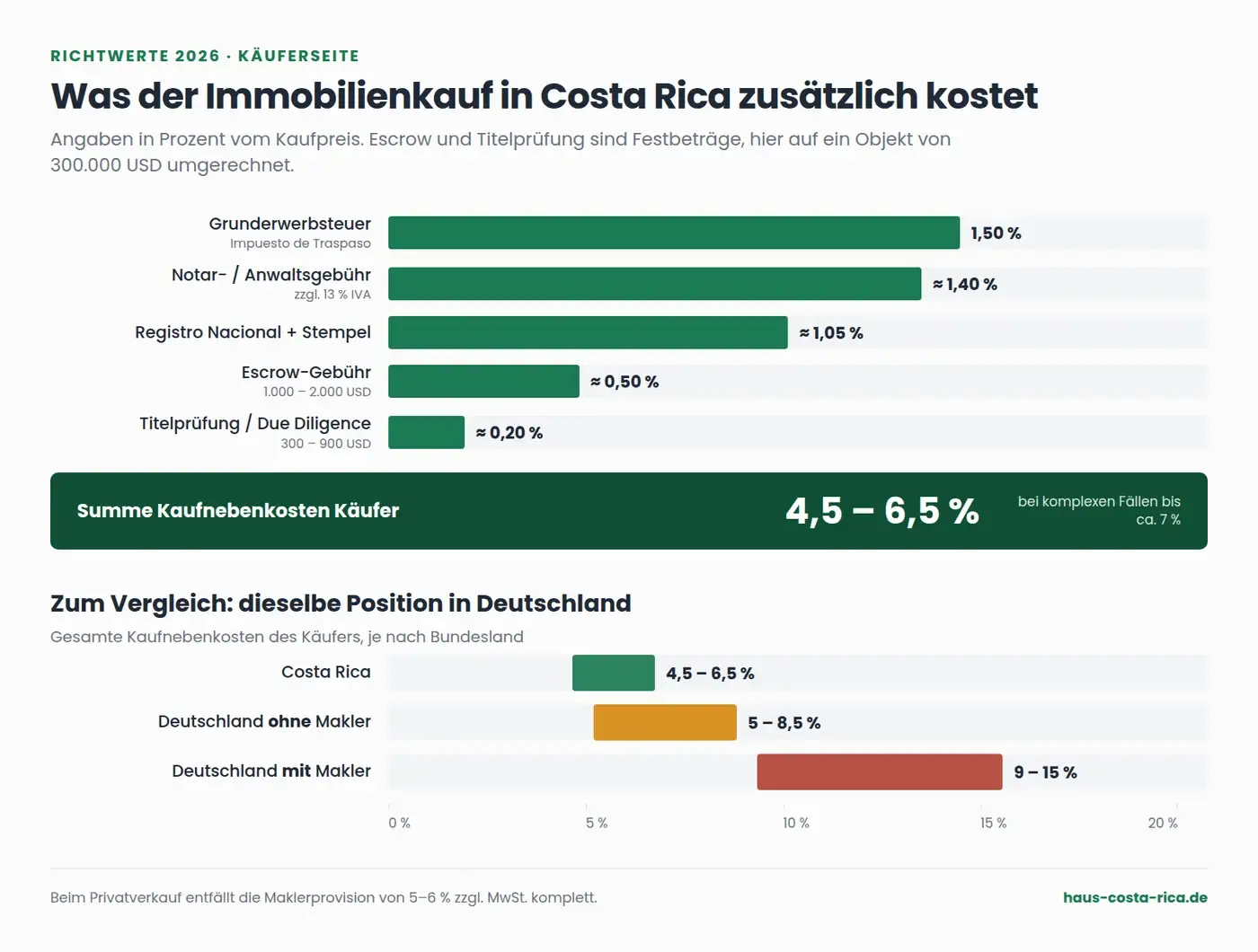
Here are the figures everyone is looking for and that few people state openly. Reference values for 2026:
| Item | Amount | Who typically pays |
|---|---|---|
| Transfer tax (Impuesto de Traspaso) | 1.5% of the purchase price or fiscal value (the higher value applies) | Buyer |
| Registro Nacional + stamp taxes | approx. 0.8–1.3% | Buyer |
| Notary/attorney fee | approx. 1.25–1.5% plus 13% IVA | Buyer |
| Escrow fee | approx. USD 1,000–2,000 | Buyer (often split) |
| Title search / due diligence | approx. USD 300–900 | Buyer |
| Survey / appraisal (optional, recommended) | depending on scope | Buyer |
| Real estate agent commission | 5–6% plus 13% IVA | Seller – not applicable in a private sale |
| Capital gains tax (if there is a gain) | 15% on the gain | Seller |
All in, as the buyer you should budget for about 4.5% to 6.5% in closing costs. In more complex cases it can move toward 7%, and in simple cases below that. One detail that is often overlooked: in Costa Rica, transfer tax and registry fees are traditionally split 50/50 between buyer and seller—but that is negotiable and should be explicitly stated in the purchase agreement.
For comparison, Germany: With agent commission, closing costs there are around 9% to 15% depending on the federal state—transfer tax 3.5% to 6.5%, notary and land registry 1.5% to 2%, buyer’s share of the agent commission up to 3.57%. Without an agent, Germany is around 5% to 8.5%. So for private sales, Costa Rica is roughly on par with Germany, and with an agent it is significantly lower—the big difference comes later, with ongoing property tax.
Ongoing costs afterwards
To make the calculation complete, here are the annual costs of ownership:
- Property tax (Impuesto sobre Bienes Inmuebles): 0.25% of the registered fiscal value per year, collected by the municipality. With a registered value of USD 300,000, that is about USD 750 per year. If you are coming from Germany, you will read that twice.
- Luxury tax (Impuesto Solidario): The trigger is the building value including fixed installations—for 2026, the exemption threshold is 143 million colones (Decreto Ejecutivo 45358-H), roughly USD 300,000. Important and often misrepresented: If the threshold is exceeded, the tax is then calculated on the total value including the land. The rates are tiered from 0.25% to 0.55%. It is due on January 15, declared via form D-174 in the TRIBU-CR system.
- Annual Sociedad fee: If you hold the property through a company, you pay an annual corporate tax and need an Agente Residente.
The 7 most expensive pitfalls—and how to avoid them
Pitfall 1: The coastal zone (Zona Marítimo Terrestre)
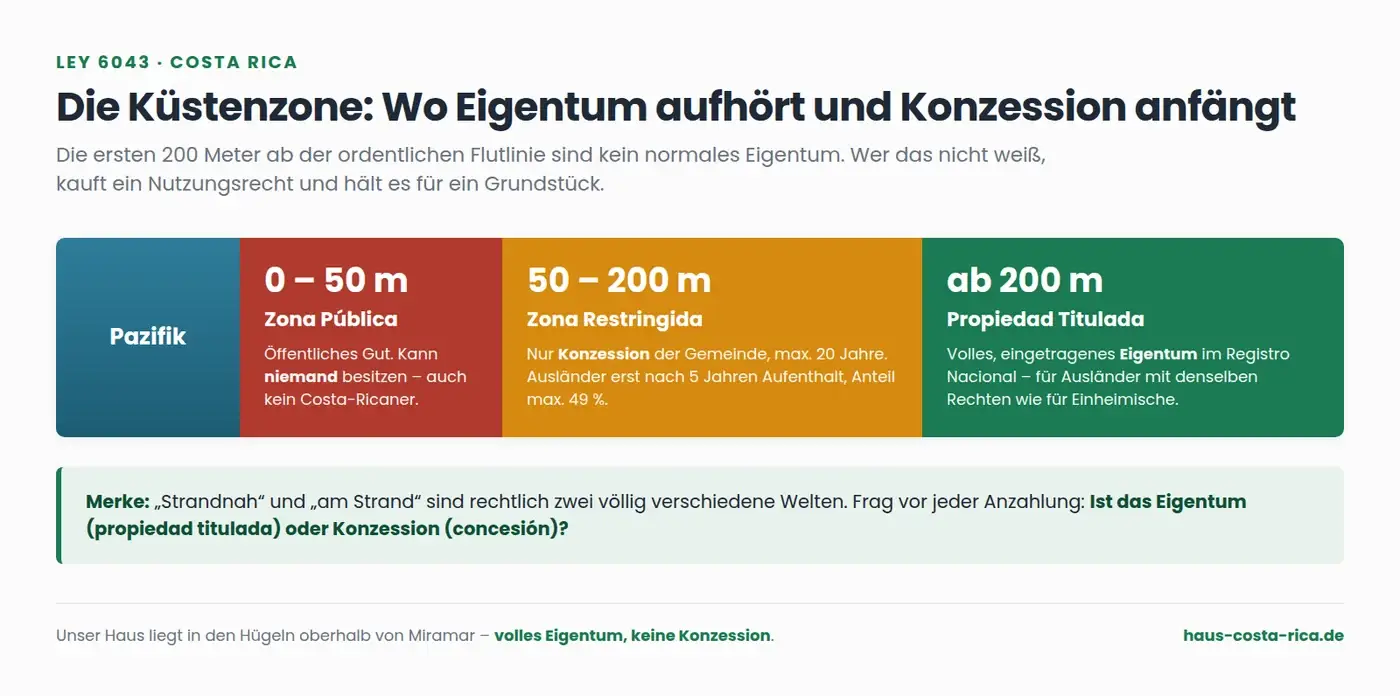
This is governed by Ley 6043. The first 50 meters from the ordinary high-tide line are public land (zona pública)—no one can own it. The next 150 meters are concession land (zona restringida): you do not acquire ownership, but a time-limited right of use from the municipality, for a maximum of 20 years, after which it must be renewed.
And Article 47 is clear: a concession may not be granted to foreigners who have not lived in the country continuously for at least five years—nor to companies domiciled abroad, with bearer shares, or with more than 50% foreign capital. For a foreigner, that means a maximum share of 49%.
That is exactly why beachfront properties are often sold through structures with local majority shareholders. This is legally delicate and becomes a problem on resale.
Remember: “Near the beach” and “on the beach” are legally two completely different worlds. Always ask: Is it ownership (propiedad titulada) or a concession (concesión)?
Pitfall 2: Possession without title (derecho de posesión)
Not every parcel in Costa Rica is registered in the land registry. There are areas held only under a right of possession—without a Folio Real, without registration. It can be sold, but it is not ownership, is hard to finance, hard to resell, and vulnerable to challenge.
Remember: No Folio Real, no purchase. Period.
Pitfall 3: Buying through a Sociedad—without knowing what it costs
Buying through a Costa Rican company is common and has real advantages for resale. But it has two catches:
First, you take on the company’s past along with it—old debts, unpaid taxes, old contracts. Second—and this is crucial for expats: a property held in a Sociedad generally does not count for the investor residence permit. Migración typically wants to see you personally in the land registry.
More on this in the post Buying property = residence permit.
Pitfall 4: Incorrect boundaries (plano catastrado)
The official survey plan and the on-the-ground reality differ more often than you would think: a fence is two meters off, an access road runs over a neighbor’s land, a corner belongs to someone else. The most common disputes involving foreign buyers are exactly this: informal access routes, shared paths, and fences that do not match the registration.
Remember: Have the boundaries confirmed by your own surveyor (topógrafo), not the seller’s.
Pitfall 5: No secured access (servidumbre)
A dream property without a registered right of way is a problem that only becomes obvious when the neighbor changes their mind. Verbal agreements between neighbors (“the road has always been used”) are not a right.
Remember: Access and right of way must be in the land registry or be a public road.
Pitfall 6: Water (carta de agua)
In rural areas, this is the most critical point of all. A property can be beautiful and still have no secured right to drinking water. Municipal water providers grant only a limited number of new connections; wells require permits.
Remember: Ask to see written water availability (carta de disponibilidad de agua) from the municipality or ASADA—before the down payment.
Pitfall 7: Liabilities that transfer to you
The land registry lists not only owners, but also mortgages, liens (embargos), easements, and anotaciones preventivas—provisional notes from ongoing proceedings that are not a formal mortgage but can still block the transaction. In addition, unpaid property taxes and municipal fees attach to the property and transfer to the new owner.
Remember: Obtain the Certificación Literal from the Registro Nacional yourself—or through an attorney you trust, not the seller’s.
The biggest red flag of all: If someone pressures you to pay the down payment before the land registry review is complete. A reputable seller has no problem with you checking first.
Your due diligence checklist to print
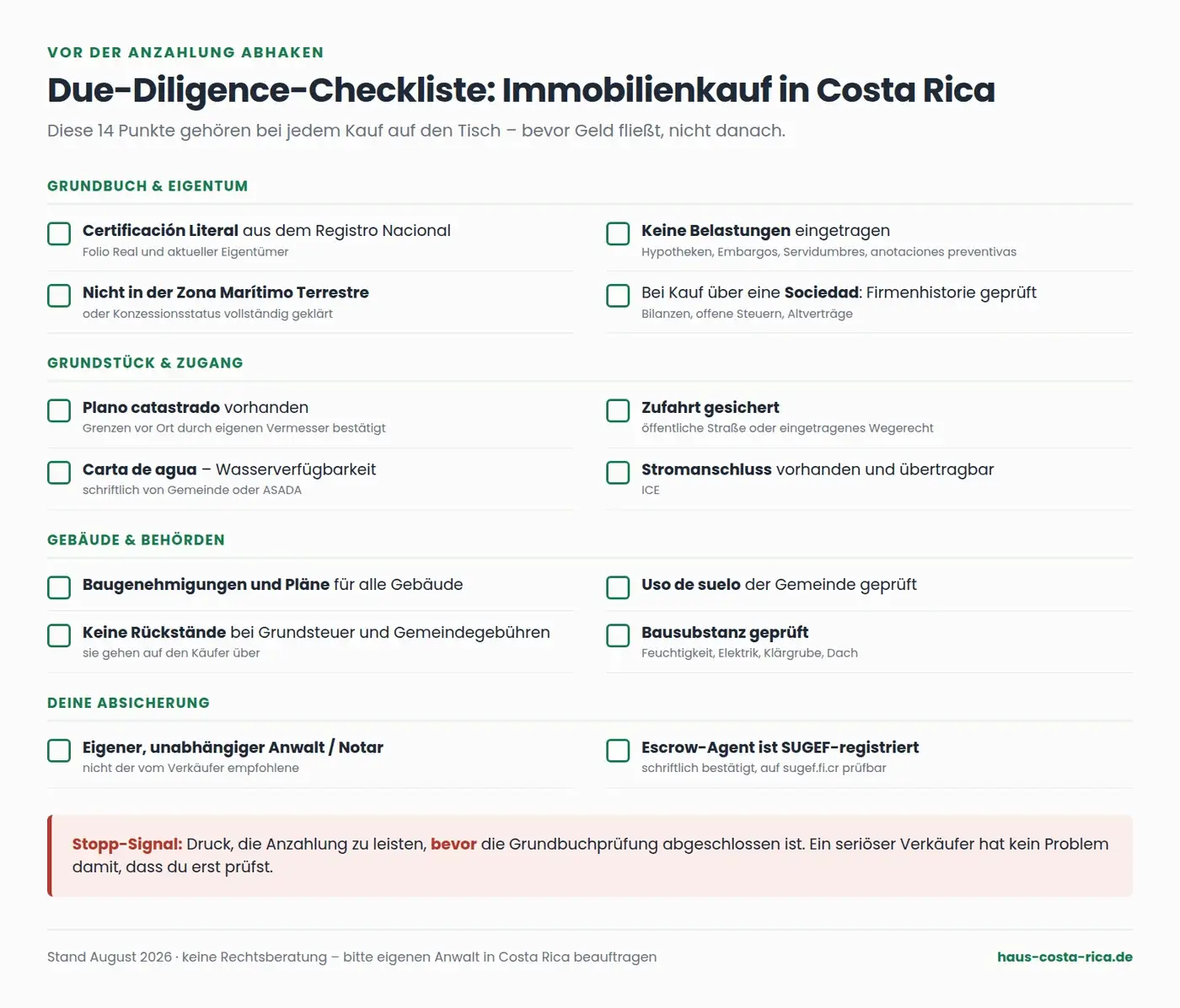
These points should be on the table for every purchase in Costa Rica:
- Certificación Literal from the Registro Nacional (Folio Real, current owner)
- No mortgages, embargos, servidumbres, or anotaciones preventivas registered
- Plano catastrado available—and boundaries on site confirmed by your own surveyor
- Access secured: public road or registered right of way
- Carta de agua / water availability in writing from the municipality or ASADA
- Electricity connection (ICE) in place and transferable
- Building permits and plans available for all structures
- Uso de suelo (municipal land-use certificate) checked
- Property taxes and municipal fees paid with no arrears
- Not in the Zona Marítimo Terrestre—or concession status fully clarified
- If buying via a Sociedad: company history, financial statements, unpaid taxes checked
- Your own independent attorney/notary—not the one recommended by the seller
- Escrow agent is SUGEF-registered—confirmed in writing
- Building condition checked: moisture, electrical, septic/sewer, roof
The three defects sellers most often hide worldwide are the same here: moisture damage behind fresh paint, improvised wiring inside walls, and undersized water or septic systems. A building inspector costs little by comparison.
What skipping the agent really changes
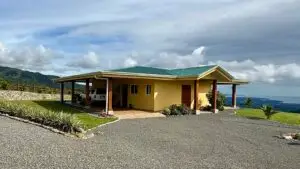
I am selling my house above Miramar directly, without an agent. What that means for a buyer—honestly, from both sides:
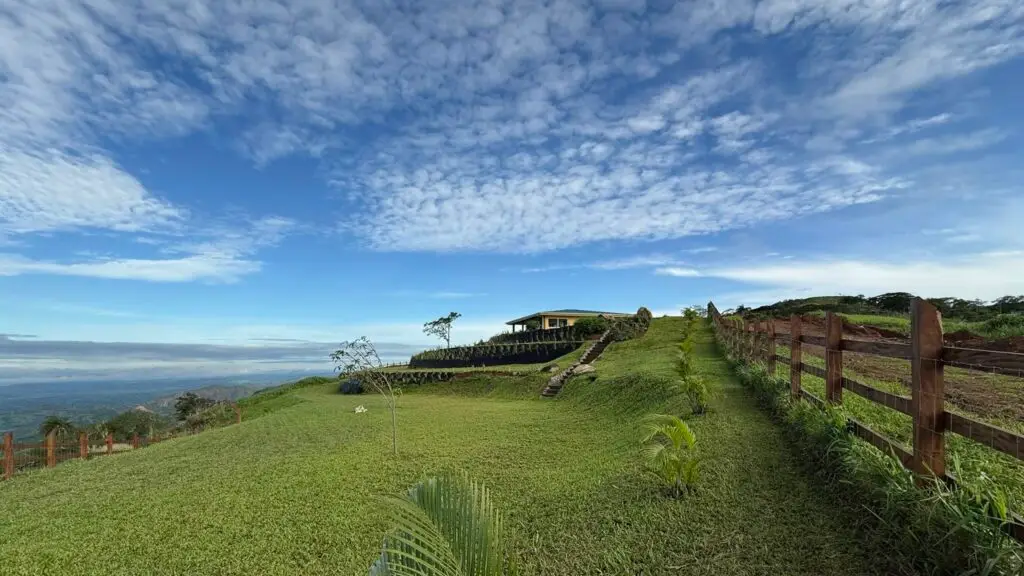
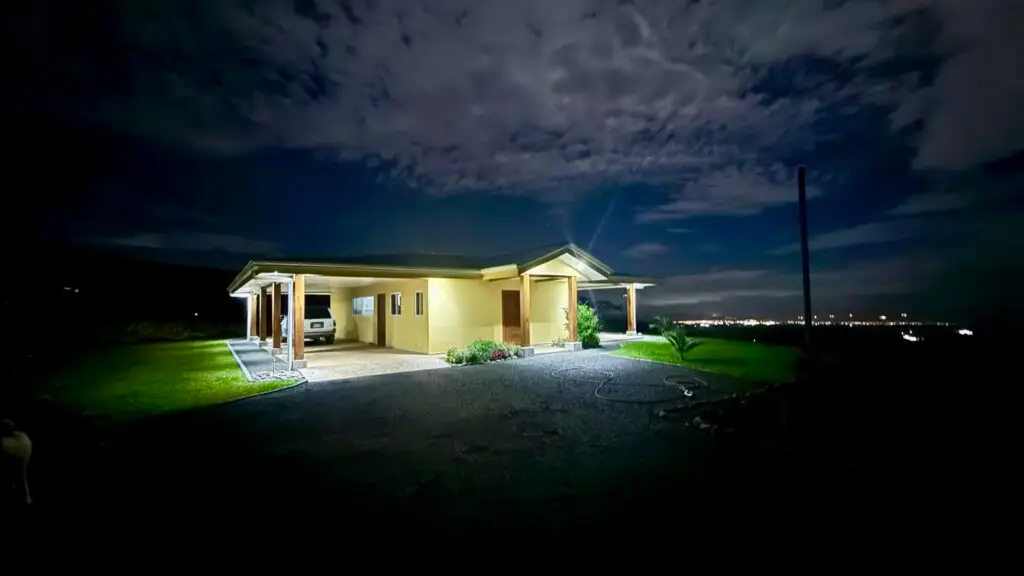
The advantage: There is no 5% to 6% commission plus VAT that has to be built into the price. You speak with the person who built and lived in the house—not someone who only knows it from a data sheet. I can answer questions about water lines, electricity consumption, the neighborhood, or construction decisions directly. And the purchase structure can be set up from the start in the way that suits you—for example, in your personal name if you are aiming for residency.
The honest counterpoint: An agent normally takes over parts of the coordination. In a private sale, you therefore need your own attorney even more clearly—and you should have one anyway, even with an agent-listed property. Because the agent is paid by the seller. They are not your representative.
In other words: protection when buying real estate in Costa Rica does not come from the agent. It comes from the land registry, an independent attorney, and a regulated escrow account. With a private sale, you have all three just the same—only without the commission.
I work with a written purchase option agreement, which I can also provide in a German translation. You should understand what you are signing.
Conclusion: Buying safely is a matter of sequence
Costa Rica is a well-regulated market for European buyers: full ownership for foreigners, a central land registry, mandatory notary, regulated escrow account—and closing costs of around 4.5% to 6.5%. The ongoing property tax of 0.25% is the real surprise for many.
The mistakes do not happen when buying. They happen when you mix up the order: wiring money before the checks are done. Using the seller’s attorney. Relying on verbal promises about water and right of way.
If you check first and pay second, buying here is as safe as in Europe.
Would you like to go through this using a specific property?
Take a look at the house with 5,000 m² of land above Miramar, browse the gallery, or schedule a viewing—on site or via WhatsApp video call. If you are interested in how a purchase becomes a residence permit, read Buying property = residence permit. And what it costs to live here per month is covered in Cost of living in Costa Rica.
This post reflects the research status as of August 16, 2026 and does not replace legal or tax advice. Fees, tax rates, and thresholds may change and depend on the individual case. For every real estate purchase in Costa Rica, hire your own independent, locally licensed attorney.