Most people who talk to me about the house eventually ask the same question – usually after the price, the photos, and the location, but it always comes: “And how long am I actually allowed to stay?”
The answer surprises many. In Costa Rica, buying property is not just a housing decision. It is one of the most direct paths to a residency permit for the whole family. The country has its own category for this: the Inversionista, or investor status. And those who are buying a house anyway fulfill the requirement practically as a side effect.
At the same time, something important changed this summer. On July 14, 2026, the law Ley 9996 expired – the law that provided significant benefits to expats for five years. What this means for newcomers is the second part of this post. And I will say right away: in one area, the situation is currently to be honest, unclear – I will show you exactly where.
The short answer: How the leverage works
As a tourist, you can stay in Costa Rica for up to 180 days at a time – since the increase from the previous 90 days. Important: This is an upper limit, not a legal right. The officer at the border determines the duration in each individual case and regularly stamps in less. That is enough for a long winter, but not for a life. Those who want to stay need one of the official residency permits.
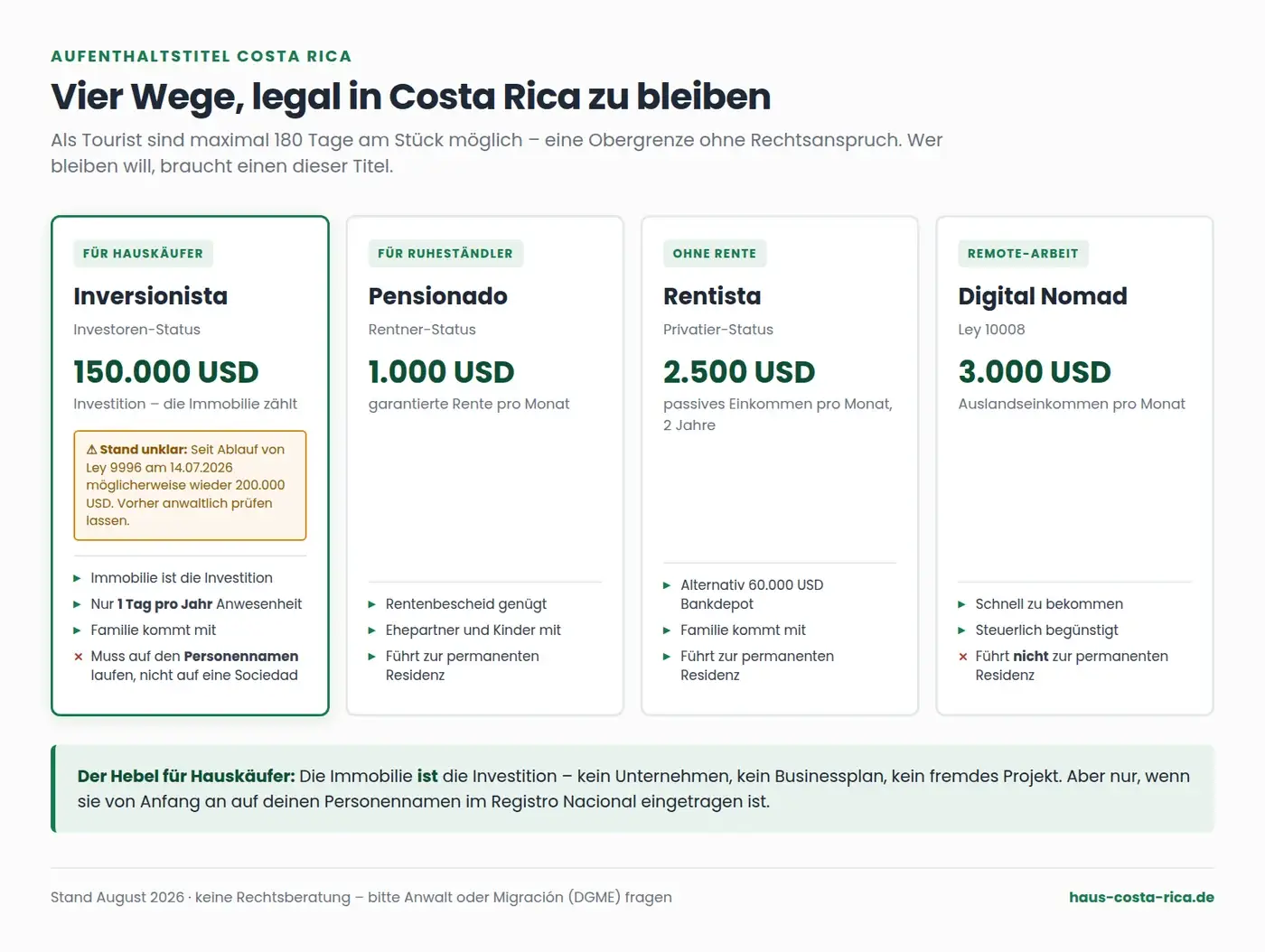
Costa Rica essentially offers four paths for this:
| Category | Requirement | For whom |
|---|---|---|
| Inversionista (Investor) | Investment from $150,000 – since the expiration of Ley 9996 on July 14, 2026, possibly $200,000 again (see below). Real estate counts. | Buyers of a house or land |
| Pensionado (Retiree) | $1,000/month guaranteed pension | Retirees with a pension statement |
| Rentista (Privateer) | $2,500/month passive income over 2 years – or a $60,000 bank deposit | People without a pension but with savings |
| Digital Nomad | $3,000/month income from abroad | Remote workers – but: does not lead to permanent residency |
A reduced threshold of $100,000 applies to approved reforestation and forestry projects – usually not relevant for house buyers.
The crucial point for house buyers: The property itself is the investment. You do not have to start a company, put money into someone else’s project, or present a business plan. The house you want to live in is simultaneously your ticket to a residency permit.
And the permit does not just apply to you: Spouses and dependent children can come along as dependent applicants. One investment, one process, one family.
The mistake that destroys the entire leverage
Now comes the part that many find out too late – and which can become very expensive.
In Costa Rica, it has been common for decades to buy real estate through a Sociedad – a Costa Rican corporation (S.A. or S.R.L.). Lawyers and brokers like to recommend this: it simplifies later sales because you then transfer the company instead of the property, saving on property transfer tax.
For residency, this is exactly the problem. Migración requires that you, as the applicant, are personally listed as the registered owner in the Registro Nacional – not a company in which you hold shares.
What this means in practice: People buy a house for many times the minimum amount, hold it through a Sociedad, apply for residency years later – and then find out that their investment is not recognized for it. Transferring it from the company to a personal name is possible afterward, but costs property transfer tax, notary fees, and time all over again.
The consequence is simple and important enough to put in bold: If you want residency through the property, it must be in your name from the very beginning. This decision is made before the notary appointment – afterward, it is expensive to correct.
What has changed since July 14, 2026
For five years, there was a welcome package in Costa Rica. The law Ley 9996 (“Law for the Attraction of Investors, Rentistas, and Pensionados”) came into force in July 2021 and offered new residents, among other things:
- a one-time duty-free import of household goods and moving items
- the duty-free import of up to two vehicles for private use
- a 20 percent discount on the property transfer tax when buying real estate
- Income tax exemption on the foreign income used to qualify
- duty-free import of professional and scientific equipment
These benefits were limited in the law to five years from the date it came into force. This period expired on July 14, 2026.
For everyone who has already received the benefits: They keep them – the law guarantees the granted benefits for ten years from the date of granting. Anyone who imported their car duty-free must keep it for that long, otherwise taxes may be reclaimed.
For new applications from summer 2026: The residency categories themselves remain in place. Inversionista, Pensionado, and Rentista still exist, and the path through property continues to work. What is gone are the extras – the duty-free container, the two vehicles, the tax discount.

And now the point where I have to be honest
Ley 9996 had lowered the minimum investment for Inversionista status from $200,000 to $150,000. The question everyone is asking now: Does it rise back to $200,000 with the expiration of the law?
I have not found a reliable answer to this – and that is the honest information. In August 2026, I checked several specialized sources: immigration law firms in Costa Rica, international immigration consultants, and legal publications. The expert consensus shortly before the deadline was unanimous: Without an extension law from the National Assembly, a return to $200,000 is expected. I have found no source confirming an extension – but also none that officially proves the actual return to $200,000 after July 14, 2026. Several consulting sites still list $150,000, while at least one Costa Rican firm already lists $200,000 again.
In other words: The threshold cannot currently be reliably named. Anyone who claims otherwise either has a source I haven’t found – or they are copying an old status.
For you as a prospective buyer, this means:
- Have the current status confirmed in writing by a Costa Rican lawyer or directly by Migración (DGME) before you buy – not by a broker, not by a blog, not even by this one.
- The question becomes practically relevant primarily in the range between $150,000 and $200,000. Anyone above that fulfills both thresholds – the uncertainty does not affect them.
- If you are planning to buy anyway: Waiting does not make things any more certain. The threshold can rise; historically, it has never fallen – except through Ley 9996.
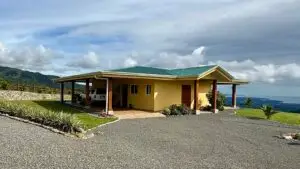
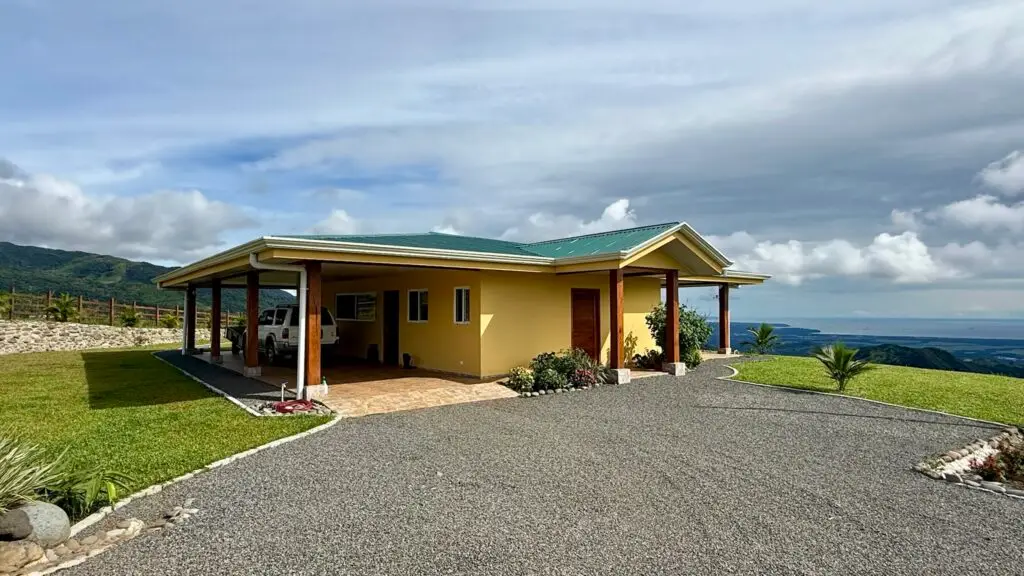
Our house above Miramar is well above both discussed thresholds. For a buyer, this lack of clarity is not an issue here – the Inversionista path remains open in any case.
The Process: From the Escritura to the DIMEX Card
How does it work specifically once you have bought the house?
Step 1 – Register Ownership
After the notary appointment (Escritura), the transfer is registered with the Registro Nacional. Realistically, expect two to six weeks – 10 to 15 working days is the best-case scenario for an already digitized file. From the moment of registration, you are the registered owner – the foundation for everything else.
Step 2 – Gather Documents
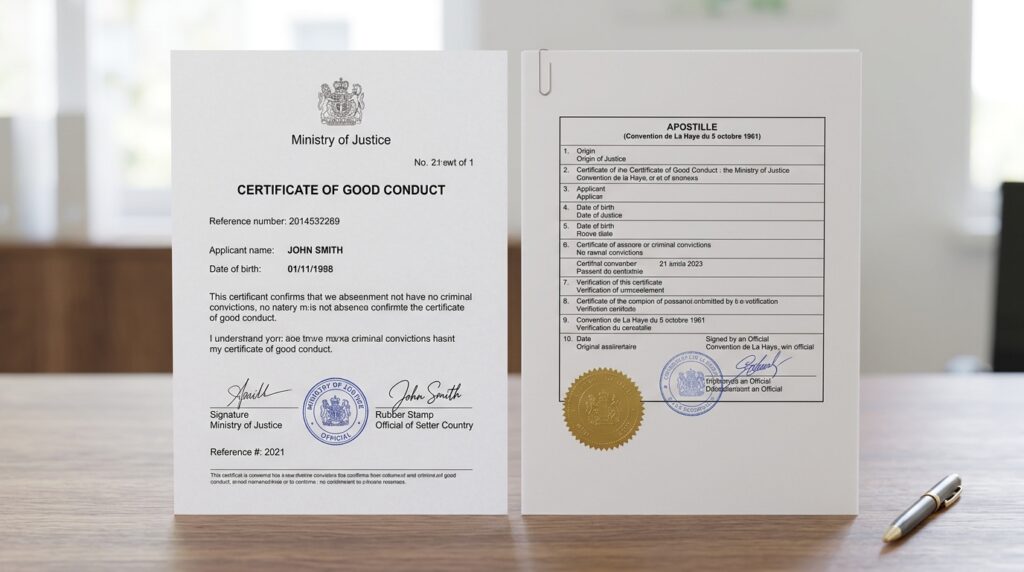
Migración typically requires: a valid passport, apostilled birth certificate (usually not older than six months), police clearance certificate from every country where you have lived for at least two consecutive years in recent years, apostilled marriage or divorce certificates, certified Spanish translations of all documents, passport photos, fingerprints at the Ministry of Security – and of course proof of ownership of the property.
A practical tip: Take care of apostilles and police clearance certificates while you are still in Europe. Doing it from Costa Rica takes many times longer.
Step 3 – Application and Waiting Period
Processing takes 6 to 18 months depending on the source; 9 to 12 months are frequently cited. After that, it takes another two to three months until the DIMEX card, the actual residency ID.
Step 4 – Register with Caja
Every approved resident must register with the state health insurance CCSS (“Caja”). This is mandatory, not optional. The contribution is based on the declared income and covers spouses and children. I have described how the system works and what it realistically costs in detail here: Health Insurance in Costa Rica.
The costs of the procedure are manageable: government fees are typically around $200 to $350, a specialized lawyer often charges $750 to $1,350 as a flat fee, plus translations and apostilles. Compared to a property purchase, this is a minor expense.
What happens next: The long road to a passport
Inversionista status is a temporary residency, valid for two years and renewable as long as the investment exists. After that, two further stages open up:
- After 3 years of continuous legal residency, you can apply for permanent residency. This releases you from the investment requirement and allows you to work in Costa Rica.
- After 7 years, naturalization is possible for Germans, Austrians, and Swiss – through the Electoral Tribunal (TSE), with Spanish language skills and a test on national knowledge. (For citizens of Ibero-American countries and Spain, 5 years are sufficient.) Costa Rica allows dual citizenship – you do not have to give up your German passport.
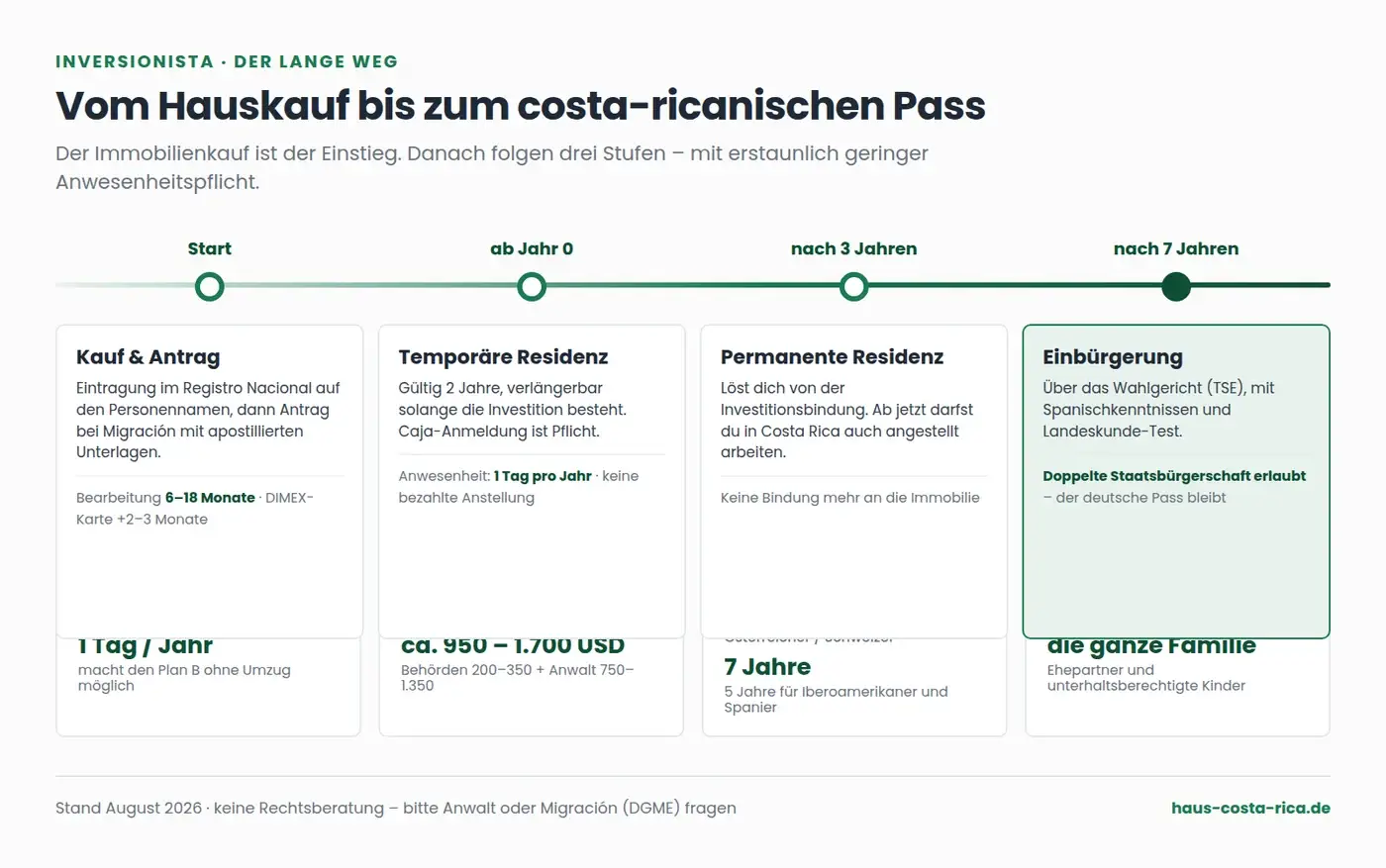
A detail that surprises many and is important for people who don’t want to fully emigrate yet: The physical presence requirement is minimal. For the Inversionista, according to consistent sources, it is sufficient to enter the country once per year to maintain the status. However, those seeking permanent residency should avoid long absences – these can raise questions during renewal.
This makes the path interesting even for people who initially just want a Plan B: a house, a residency permit, an open door – without having to pack up everything in Europe tomorrow.
What the permit does not give you
To keep this post honest, the limitations must also be included:
The temporary investor residency does not allow you to have paid employment in Costa Rica. You may be 100 percent owner of a company, manage it, hire employees, and receive dividends – but you cannot pay yourself a salary or be employed by a Costa Rican employer. This only changes with permanent residency after three years.
The permit is also tied to the investment. If you sell the property in the first three years without reinvesting an equivalent amount, the basis for the permit is lost.
And: A residency permit is not a tax residence. Whether and where you become liable for tax is determined by completely different rules – in Germany by residence and habitual abode, in Costa Rica by the territorial principle. This is a separate topic for your tax advisor, not for a blog post.
Conclusion: Two birds, one decision
When you buy a house in Costa Rica, you are buying more than four walls. You are acquiring – with the right setup – the most direct path to a residency permit for the whole family, with minimal presence requirements and a clear perspective for permanent residency and citizenship.
The three things you should take away from this:
- Buy in your personal name if residency is a goal – not through a Sociedad.
- Have the currently applicable investment threshold confirmed in writing before you sign. Since the expiration of Ley 9996 on July 14, 2026, the status is not clear.
- Obtain apostilles and police clearance certificates in Europe before you come.
Our house above Miramar fulfills the requirements by far – built in 2024 to European construction standards, on 5,000 m² of its own land, with a view over the Gulf of Nicoya. And because I sell directly and without a broker, you can set up the structure of the purchase from the beginning in a way that fits your residency, instead of taking over a pre-existing construct.
What could that look like specifically?
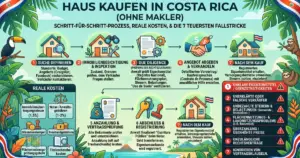
Take a look at the house with 5,000 m² of land above Miramar or schedule a viewing – on-site or via WhatsApp video call. If you want to know how the purchase itself works, read the post Buying a House in Costa Rica – Without a Broker, Step by Step. And what life costs here monthly can be found in Cost of Living in Costa Rica.
This post reflects the research status as of August 16, 2026, and does not replace legal or tax advice. Immigration law and investment thresholds can change at short notice – especially after the expiration of Ley 9996 on July 14, 2026. Have the status applicable to you confirmed by a lawyer licensed in Costa Rica before making a purchase decision.